I’ve been reading a biography of Alan Turning, Alan Turning: The Enigma, written by Andrew Hodges. The Imitation Game comes out in the cinema soon and I want to educate myself a bit before I see the film. It’s quite interesting despite Hodges’ extensive discussion of mathematics which will probably get even more complicated as I continue to read. It’s important stuff so I’m really trying to train my brain not to automatically shut down at the first mention of any sort of maths. I really want to understand it but I have never been good with numbers (says the former bookkeeper).
Mathematics aside, what I’m enjoying most, so far, are the snippets of letters that are used to illustrate some of Turning’s history and drive his story forward. These are letters to and from Turning between his first love (and probably first friend), that boy’s mother, Turing’s mother, and even early letters he sent to his parents while he was away at boarding school starting at age 9. It’s brilliant to read those early, unedited, letters because they were clearly written by a child…run on sentences and all.
It’s hard to believe that, not too long ago, letter writing was how we communicated with each other. Email and text messages are still relatively new forms of communication. It wasn’t so many years ago that we used pen and paper to send messages to each other. In school, we passed notes instead of text messaging. If we had friends who lived in a different area, we probably wrote them letters to update them on our lives, instead of using emails or Facebook.
I used to write letters all the time, mostly to my grandmother. We wrote back and forth when I was a child (apparently she kept my letters?) and I remember even writing her in my early 20s back in the 1990s (gasp!) when I was living on the opposite side of the U.S. from her. I also wrote a couple of friends back home because a stamp was less expensive than a long distance phone call.
Being a word-nerd, writing letters seemed easier than chatting on the phone. Written words are different than the spoken word, in my opinion. We tend to think about what we are going to write before it hits the page while spoken words tend to spill out our mouths with less thought, or maybe that’s just me! Letters tend to have a certain eloquence to them that we miss when speaking. There is the formality of a letter that helps that along. The whole idea of a salutation like Dear ______, is kind of lovely and something you don’t tend to do in regular dialogue. Granted, you do miss out on inflection when writing but that’s why underlining or all caps are useful.
I’m trying to remember the last hand written letter I received. I’m afraid it might be a letter from The Blonde Child about five years ago. Not my favourite letter so I’m going to ignore it. In that case, it will probably have to be a letter from my grandmother when we were writing back in 1993…21 years ago. That’s an awful long time ago.
Now we have email. We don’t need to write with a pen on paper. I get emails often, especially now that I live in England and most of my friends and family are still based in the United States. I enjoy those emails. I even get them from my father. They are short emails, granted, but I applaud his attempt to use technology despite not being very fond of email.
The thing about email is that no matter how heartfelt or personal the message may be it’s still somewhat sterile. There it is, on your computer or mobile screen, glaring at you. It’s typed out and somewhat spell-checked and clean. There are no scratch-outs of wrong words or goofed up spelling. There aren’t any doodles in the margins from when the writer got distracted or was thinking of what to say next. There aren’t any ink spots from where your hand dragged over a gob of ink left by your crap pen. Emails are sterile. There is no other word for it. Oh, and unless you print an email there is nothing to crumple up and chuck across the room when the contents pisses you off!
Keeping along that line of thinking, what do you do when you get an email that gets your ire up? You automatically click “Reply” and tear into the sender. Come on, you know you do it. Sometimes you don’t even save the unfriendly reply as a draft to look over when you’ve cooled down. You click “Send” and often regret it.
With physically writing a letter there is a bit of a pause—if anything to find the above mentioned crap pen and a sheet or two of paper. The actual act of writing tends to calm the brain a bit (at least mine). Also, even if you still manage to write back with your anger pumping through your pen, you still have to go through the motions of finding and envelope, a stamp, and addressing the envelope. This takes time. And, unless the postman is standing at your door or you are next to a post box there is even more downtime for that angry letter to sit and cool and your rational mind to consider your words. What I’m getting at here is writing and sending a letter takes more thought than clicking the “Send” button. This is sometimes a good thing, a relationship saving thing.
Now, you may be saying, “Seriously? You are expounding on the glories of writing letters as you type this post into a digital format where you’ll then market it by using Facebook and Twitter? Hypocrite! You are hardly someone who can disparage technology such as email!”
I’m not disparaging it at all. I love technology. My dissertation is focused on social media marketing use by London theatres. I text. I email. And I rarely use my phone as an actual phone. I’m just saying there is something about letter writing that I miss. I miss receiving letters in the mail (they are so much better than bills or bank statements). Besides, if you doubt my commitment to using paper and pen to write, I will share with you that almost every post I write starts out handwritten. I’m old-school like that.
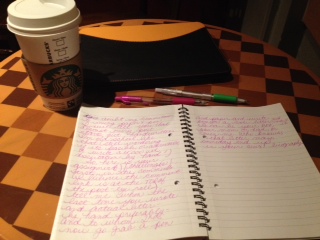
So, here are your assignments (What? She’s giving assignments now?). Actually, let me call them challenges. First, in the Comments at the end of this post, share the last time you hand-wrote a letter and who you wrote it to. Covering letters for resumes/CVs don’t count. Second, go grab a pen and some paper and write a nice letter to someone and mail it to them. It can be your best friend, your mom or dad, or even me. (Yes, I’ll write at least one, as well.) Who knows, that letter may end up in your biography someday.

 On My Mind